
Kasauti Kit is an innovative rapid food adulteration detection kit developed by Zenomix Biolab to enable quick, simple, and reliable preliminary screening of common adulterants present in everyday food. The kit is designed to help
- Consumers,
- Food businesses,
- Educational Institutions,
- Food inspectors, and
- Laboratories
to assess food quality without requiring sophisticated laboratory equipment or specialized technical skills.
Kasauti Kit is available for a wide range of food commodities, including
- Milk,
- Ghee,
- Edible oil,
- Honey,
- Spices,
- Pulses,
- Butter,
- Jaggery,
- Paneer, and
- Dry fruits.
Each kit is specifically developed to detect the common adulterants associated with that particular commodity.
Principle of Detection
The Kasauti Kit works on the principle of selective chemical reactions between specific reagents and adulterants commonly found in food. When the test reagent comes into contact with the sample, it reacts selectively with the target adulterant, producing a distinct colour change, precipitate, or other visible reaction. The presence or absence of this reaction indicates whether the suspected adulterant is present in the sample.
Each commodity-specific kit contains carefully formulated reagents that are designed to respond only to particular adulterants, ensuring rapid and easy interpretation of results. The user compares the observed reaction with the reference guide provided in the kit to determine the preliminary status of the sample.
Key Features
- Rapid results within minutes
- Simple procedure with no laboratory required
- Easy visual interpretation of results
- Portable and suitable for field or home use
- Scientifically developed screening methodology
- Commodity-specific detection of common adulterants
MILK TESTING
PANEER TESTING
EDIBLE OIL TESTING
HONEY TESTING
SPICES TESTING
PULSES TESTING
DRY FRUITS TESTING
JAGGERY TESTING
GHEE TESTING
Multiple-Use Kasauti Kit
These kits are reagent-based and can be used 6-7 times. All the accessories required for the test are kept in the kit box.
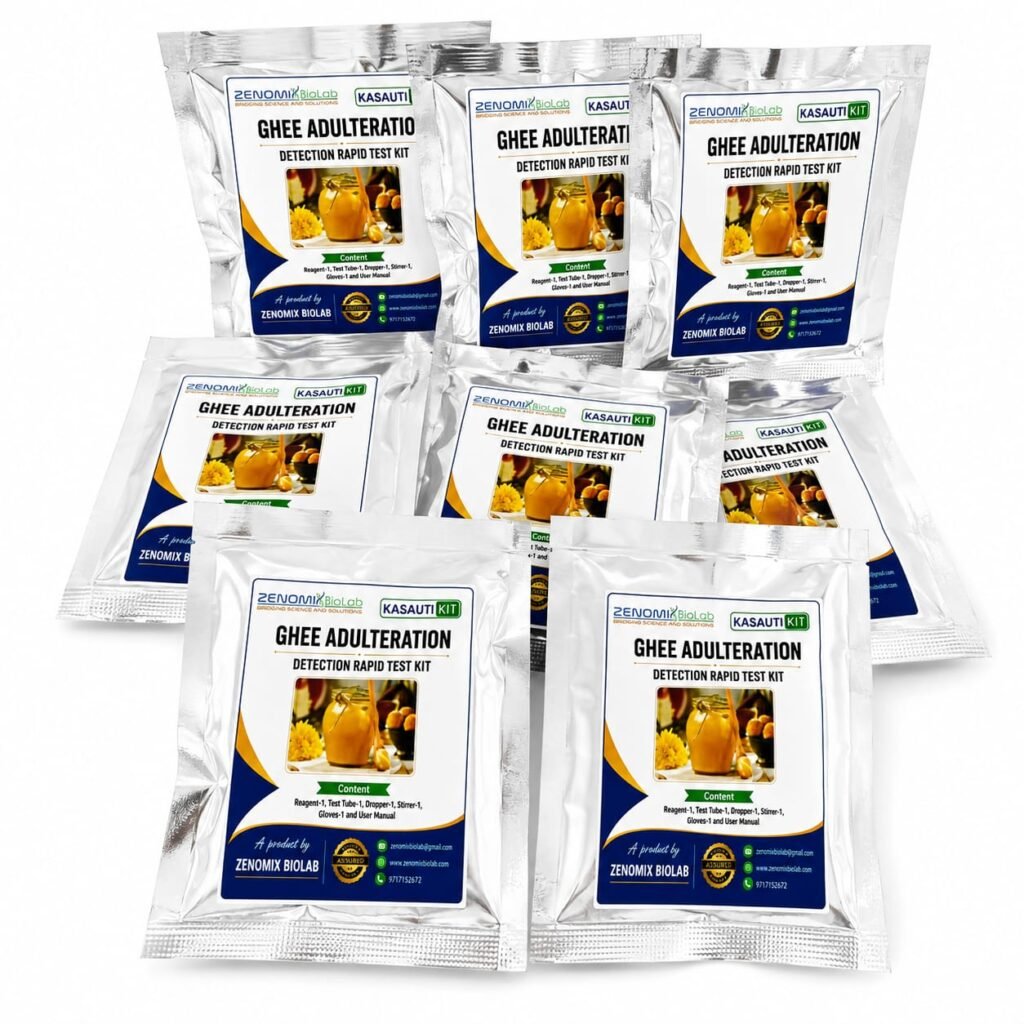
GHEE ADULTERATION DETECTION RAPID TEST KIT
घी में मिलावट की पहचान हेतु त्वरित परीक्षण किट
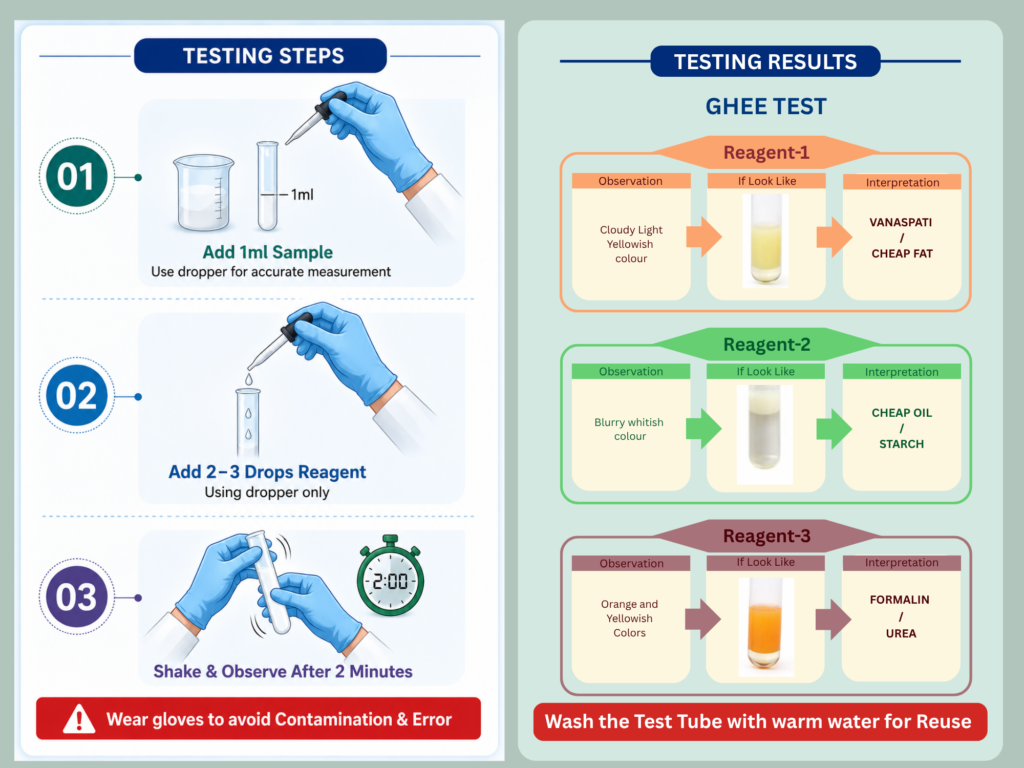
Impurities in ghee are a common issue in India. Since mashed potatoes or corn starch can be used to adulterate ghee, both the volume and the solid content can be increased. One such ingredient that is added to Ghee to adulterate it is starch. Since vanaspati and margarine are less expensive than ghee, mixing is done with them. Ghee is sometimes mixed with vegetable, plant, and cheap/animal fat by dishonest producers in an attempt to boost output and profit margins. Paraffin wax is also added by some manufacturers to enhance the consistency and texture. Wax contributes to ghee’s longer shelf life. To extend the shelf life of dairy products and ghee, preservatives such hydrogen peroxide are added. Add some ingredients to ghee, such as copper sulfate or argemone oil, to improve its color or fragrance. These substances pose a risk to human health.
HOW TO TEST
Vanaspati / Cheap fat adulteration detection procedure
- Wear the safety gloves provided in the Kit.
- Put just a small amount of melted ghee (1/4th of a teaspoon) into the provided tube.
- Add 3 drops of Reagent-1 given with the kit in Ghee.
- Could you observe the color change? Change of color to black or dark brown indicates that Ghee is adulterated with vanaspati or cheap fat.
Cheap oil, starch adulteration detection procedure
- Wear the safety gloves provided in the Kit.
- Put just a small amount of melted ghee (1/4th of a teaspoon) into the provided tube.
- Add 3 drops of Reagent-2 (Cheap oil, starch detection reagent).
- Shake & mix and then keep at rest for 1 minutes.
- Development of blurry whitish colour – Indicates the presence of Adulteration.
- The blurriness of the solution (if developed) depends on the concentration of the cheap adulterants.
Preservative detection procedure
- Wear the safety gloves provided in the kit.
- Take 1/4th teaspoon of melted ghee/butter in a test tube.
- Add 2-3 drops of Reagent-3 (preservative detection reagent).
- Development of a pinkish/brown color indicates the presence of a preservative.
MILK ADULTERATION DETECTION RAPID TEST KIT
दूध में मिलावट की पहचान हेतु त्वरित परीक्षण किट
Adulteration in milk is a serious issue in India. To increase profit margins, dishonest producers often mix starch or flour into milk to bulk up its weight, compromising its purity and nutritional value. In some cases, detergent or urea is used to make milk, which lacks the essential nutrients of fresh milk and may contain harmful chemicals like detergents. To enhance the texture and extend shelf life, some manufacturers add substances like urea, caustic soda, or sodium bicarbonate, which can be detrimental to your health. Additionally, harmful preservatives like formalin are sometimes used to keep milk from spoiling, posing serious health risks. The milk that seems fresh and wholesome may, in fact, be tainted with these dangerous additives, putting your health at risk with every ship.
HOW TO TEST
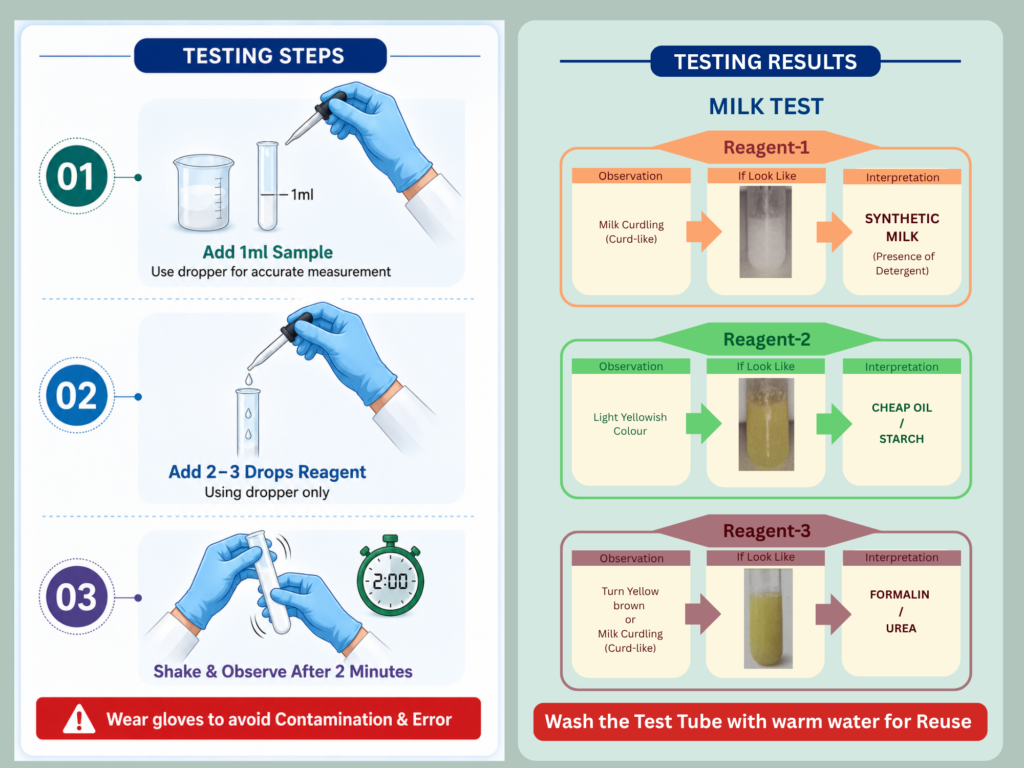
SYNTHETIC MILK MADE UP OF DETERGENT, DETECTION PROCEDURE
- Wear the safety gloves provided in the Kit.
- Take aprox. 1 ml of milk is added to a test tube given
- Add 2 to 3 drops of Reagent-1 given with the kit.
- Observe, If the milk curdles form, it indicates the synthetic milk made up of detergent.
NEUTRALIZERS DETECTION PROCEDURE
- Wear the safety gloves provided in the Kit.
- Take aprox. 1ml of milk is added to a test tube given
- Add 2-3 drops of Reagent -2
- Shake & mix, then let it rest for 2 minutes.
- Development of light yellowish colour – Indicates the presence of Adulteration.
- The darkness of the color depends on the concentration of the Neutralizers.
FORMALIN/ UREA DETECTION PROCEDURE
- Wear the safety gloves provided in the Kit.
- Take aprox. 1 ml of milk is added to a given test tube.
- Add 4-5 drops of Reagent-3 given with the kit
- If the milk turns yellow/brown or milk curdles, formation indicates the presence of Formalin/Urea.
PANEER ADULTERATION DETCTION RAPID TEST KIT
पनीर में मिलावट की पहचान हेतु त्वरित परीक्षण किट
Adulteration in paneer is a serious issue in India. To increase profit margins, dishonest producers often mix starch or flour into paneer to bulk up its weight, compromising its purity and nutritional value. In some cases, synthetic milk or milk powder is used to make paneer, which lacks the essential nutrients of fresh milk and may contain harmful chemicals like detergents. To enhance the texture and extend shelf life, some manufacturers add substances like urea, caustic soda, or sodium bicarbonate, which can be detrimental to your health. Additionally, harmful preservatives like formalin are sometimes used to keep paneer from spoiling, posing serious health risks. The paneer that seems fresh and wholesome may, in fact, be tainted with these dangerous additives, putting your health at risk with every bite.
HOW TO TEST
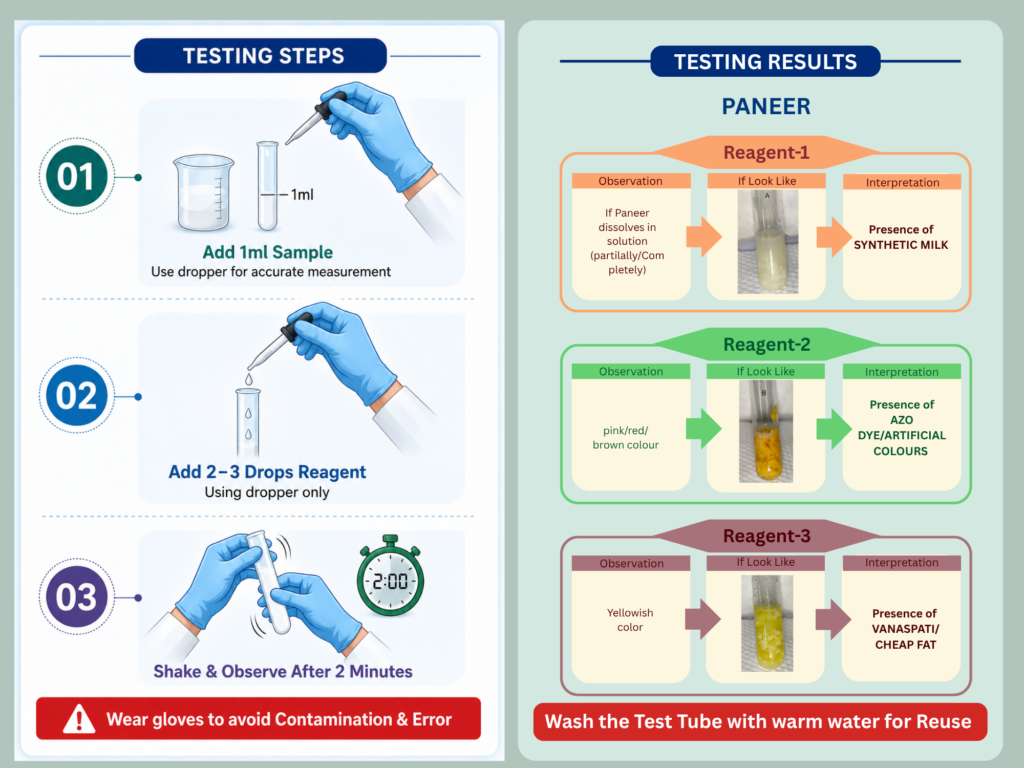
SYNTHETIC MILK ADULTERATION DETECTION PROCEDURE
- Take aprox. 0.2 gram ( about 2 pinches) of Paneer and mash it, add to the test tube given
- Add 1 ml of water to the Paneer with the help of a dropper and mix well
- Add 2 to 3 drops of synthetic milk detection Reagent-1 given with the kit in Paneer
- Observe if the paneer dissolves in the solution completely; it indicates that the Paneer is made with synthetic milk or other fillers to increase its weight. This dilutes the protein content and reduces the overall quality of Paneer.
AZO DYE/ARTIFICIAL COLOURS DETECTION PROCEDURE
- Take aprox. 0.2 grams of paneer (about 2 pinches) and mash it, add to the test tube given
- Add 1 ml of water to the Paneer with the help of a dropper and mix well.
- Add 2-3 drops of Reagent -2.
- Shake & mix, then let it rest for 2 minutes.
- Development of pink/red/brown colour – Indicates the presence of adulterants.
- The darker the color, change more the concentration of adulteration in Paneer.
VANASPATI/CHEAP FAT DETECTION PROCEDURE
- Take aprox. 0.2 grams of paneer (about 2 pinches) and mash it, add to the test tube.
- Add a dropperful of water to the Paneer and mix well.
- Add 4-5 drops of Reagent-3 given with the kit.
- If the paneer turns yellow indicates the presence of preservatives, Vanaspati, or cheap fat added to the Paneer to improve its appearance or prolong its shelf life.
Edible Oil Adulteration Detection Rapid Test Kit
खाद्य तेल मे मिलावट की पहचान हेतु त्वरित परीक्षण किट
In India, adulteration of edible oils is a common issue. Oils like mustard, groundnut, or coconut oil are often mixed with cheaper, low-quality oils like palm oil or rice bran oil to increase quantity and maximize profits. One frequent adulterant is argemone oil, a toxic substance that can cause serious health problems. Mineral oils, which are not safe for consumption, are sometimes added to edible oils to cut costs. Additionally, dishonest manufacturers may add chemical preservatives like butylated hydroxyanisole (BHA) or butylated hydroxytoluene (BHT) to extend the shelf life of the oil, exposing consumers to potential long-term health risks. Synthetic coloring agents and fragrances are also used to enhance the appearance and aroma of oils, misleading consumers about their purity. The oil you rely on for daily cooking could contain these harmful additives, putting your health and that of your family at risk.
HOW TO TEST
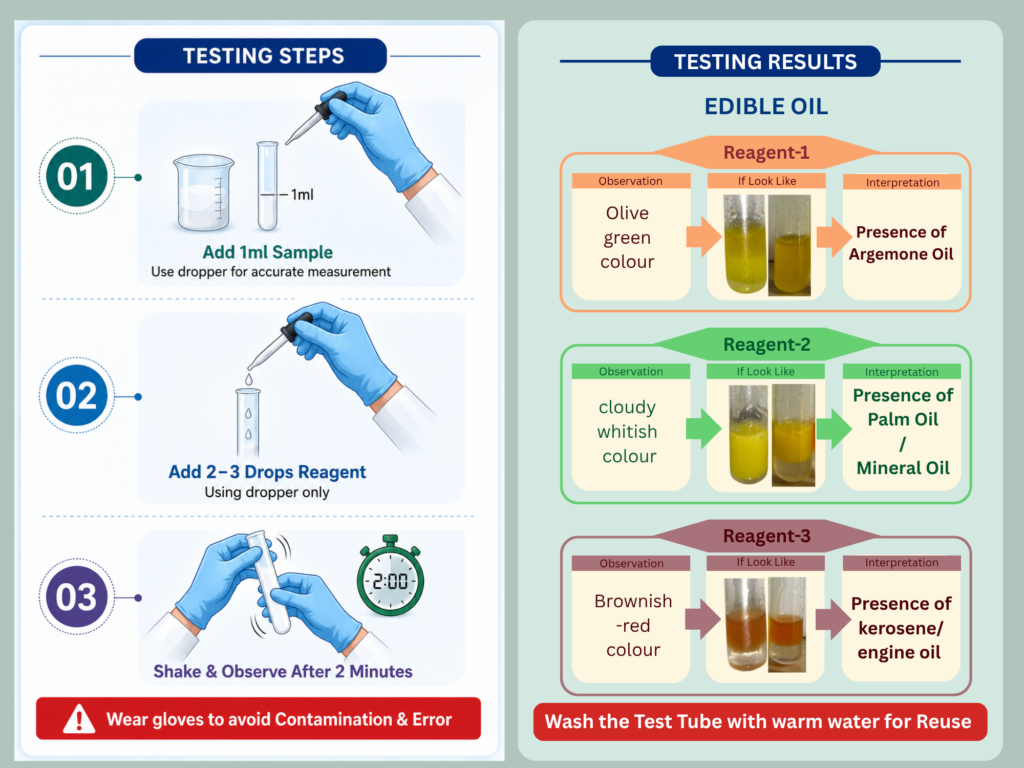
ARGEMONE OIL ADULTERATION DETECTION PROCEDURE
- Take 1ml of oil, and add it to the test tube given.
- Add 4 drops of Testing Reagent-1 to the test tube.
- Shake & mix and then keep at rest for 1 minute.
- (If) the color changes to green/olive green, it indicates the presence of Argemone oil.
MINERAL OIL OR PALM OIL ADULTERATION DETECTION PROCEDURE
- Take 1 ml of oil, and add it to a given test tube.
- Add 3-4 drops of Reagent-2 to the test tube.
- Shake & mix well and then keep at rest for 1 minute.
- Development of cloudy whitish colour – Indicates the presence of Mineral oil/palm oil Adulteration.
KEROSENE/ ENGINE OIL DETECTION PROCEDURE
- Take 1 ml of oil, and add it to the given test tube.
- Add 3 drops of Reagent-3 to the test tube.
- Shake & mix, then let it rest for 1 minute.
- Development of green/brown color indicates the presence of preservatives/artificial colors/flavors in the oil.
HONEY ADULTERATION DETECTION RAPID TEST KIT
शहद में मिलावट की पहचान हेतु त्वरित परीक्षण किट
Honey adulteration is a significant issue in many parts of the world, including India. One common practice is the addition of sugar syrup, glucose, or high-fructose corn syrup to increase volume, which compromises the natural quality of honey. Some producers even mix honey with cheaper, synthetic substitutes like jaggery syrup or rice syrup. These additives may enhance the sweetness but strip away the natural health benefits of pure honey. In some cases, honey is diluted with water to increase quantity, further reducing its potency and nutritional value. Certain unscrupulous producers also use chemicals like antibiotics or heat-treat the honey to improve its appearance and extend shelf life, but these processes can destroy the beneficial enzymes and nutrients. Additionally, additives such as artificial flavoring or coloring agents are sometimes used to mask these alterations. The honey you trust may be contaminated with substances that can negatively impact your health.
HOW TO TEST
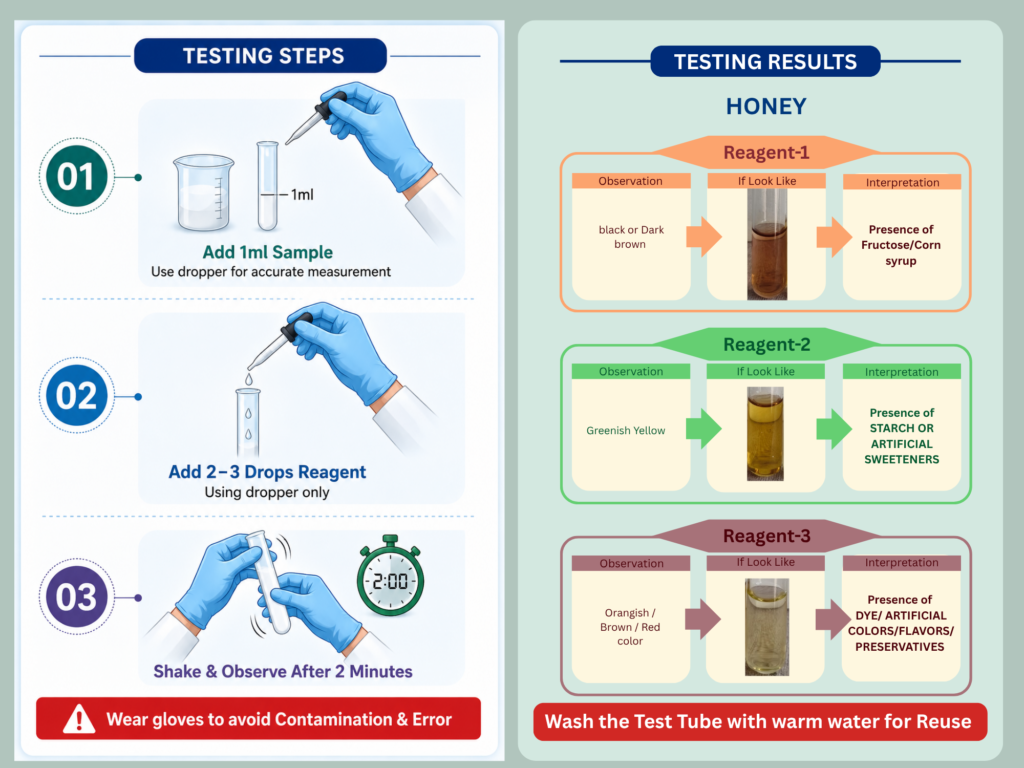
Fructose/Corn syrup ADULTERATION DETECTION PROCEDURE
- Wear the safety gloves provided in the Kit.
- Take 1 ml of Honey into a test tube given
- Add 2 to 3 drops of glucose/sugar detection Reagent-1 given with the kit in Honey.
- Observe the color change (if any). A change of color to black or brown indicates that Honey is adulterated with above mentioned adultrants.
STARCH OR ARTIFICIAL SWEETNERS ADULTERATION DETECTION PROCEDURE
- Take 1 ml of honey into the test tube given.
- Add 3 drops of Reagent-2 given with the kit in the honey.
- Shake & mix, then let it rest for 1 minute.
- Development of greenish/yellow indicates the presence of adulteration.
- The darker color change depends on the concentration of the adulterants.
DYE/ ARTIFICIAL COLORS/FLAVORS/ PRESERVATIVES DETECTION PROCEDURE
- Take 1 ml of Honey into a test tube given
- Add 4 drops of Reagent-3 given /with the kit in Honey.
- Shake & mix, then let it rest for 1 minute.
- Development of orangish/brown/ red color – Indicates the presence of preservatives/ artificial colors, and flavors in Honey to improve its appearance or prolong its shelf life.
SPICES ADULTERATION DETECTION RAPID TEST KIT
मसलों में मिलावट की पहचान हेतु त्वरित परीक्षण किट
In India, adulteration in spices is a significant issue. Spices like turmeric, chili powder, and coriander are often mixed with inferior and unsafe substances to increase weight and profit margins. For instance, turmeric is sometimes adulterated with lead chromate, a toxic yellow chemical, to enhance its color. Chili powder may be mixed with brick powder, salt powder, or artificial dyes, which not only degrade the quality but also pose health risks. Coriander powder is sometimes bulked up with sawdust or husk powder, reducing its purity. Even more alarming is the addition of toxic substances like Sudan dye in red chili powder, which is carcinogenic. Some manufacturers add metallic salts and artificial colors to improve the appearance and shelf life of spices, further endangering consumer health. What you believe to be pure, flavorful spices may be loaded with harmful chemicals and impurities.
HOW TO TEST
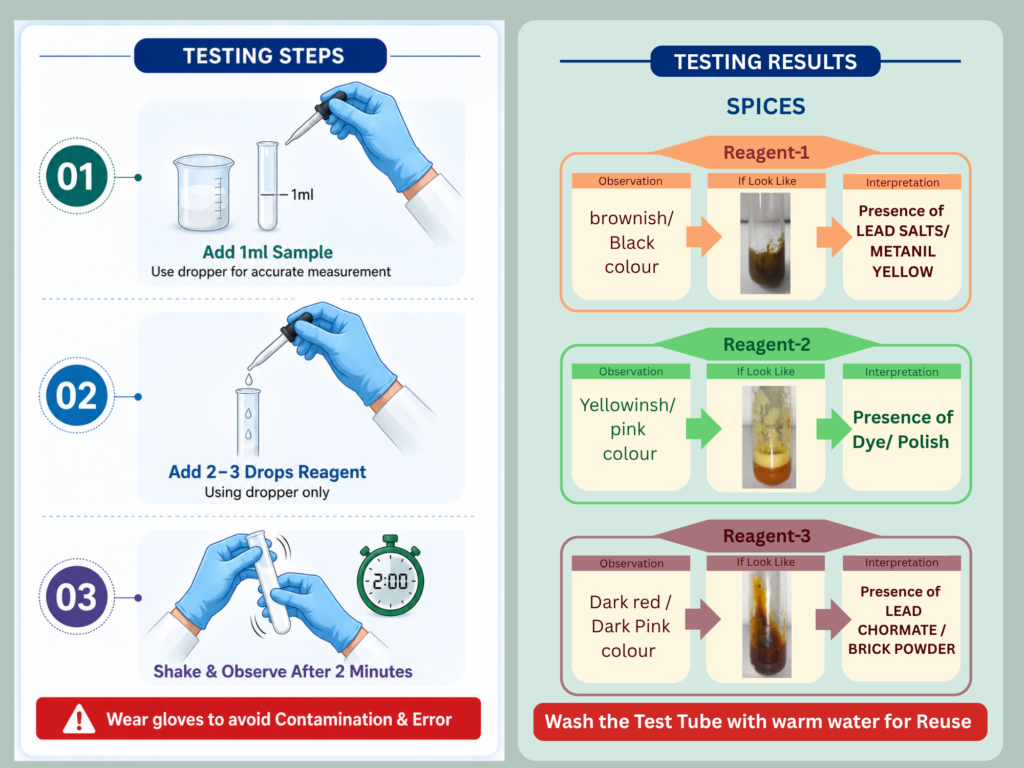
LEAD SALTS/ METANIL YELLOW ADULTERATION DETECTION PROCEDURE
- Take one pinch or 0.1 gram of any Spice powder.
- Add 0.5 ml of water with the help of a dropper (for soaking the spice), keep it for 1 minute
- Add 2 drops of the Reagent-1 to the test tube
- Mix it well and let it rest for 2 minutes.
- Observe the color change (if any). Color changed to brown/black means Spices contain lead salts/ metanil yellow adulteration.
DYE/POLISHING DETECTION PROCEDURE
- Take one pinch or 0.1 gram of any Spice powder.
- Add 0.5 ml of water with the help of a dropper (for soaking the spice), keep it for 1 minute
- Add 2 drops of the Reagent-2 to the test tube.
- Mix it and let it rest for 2 minutes.
- Observe the color change. Color changed to dark yellow/pink/red means Spices contain dye or other adulteration for color and shine enhancement of Spices.
LEAD CHROMATE/ BRICK POWDER DETECTION PROCEDURE
- Take one pinch, 0.1 gram of any Spice powder.
- Add 0.5 ml of water with the help of a dropper (for soaking the spice), keep it for 1 minute
- Add 2 drops of the Reagent-3 to the test tube.
- Mix it and let it rest for 2 minutes.
- Observe the color change (If any). Color changed in dark Red, pink, or ppt settles down means Spices contain lead chromate, brick powder, especially in turmeric and red chilli or other Spices.
PULSES ADULTERATION DETECTION RAPID TEST KIT
दालों में मिलावट की पहचान हेतु त्वरित परीक्षण किट
In India, adulteration in pulses is a significant issue. To increase the weight of pulses, unscrupulous traders often mix them with stones, pebbles, or grit. A common practice is the addition of polished or artificial colors to enhance the appearance of the pulses, making them look fresher and more vibrant than they actually are. Toxic dyes such as metanil yellow, which is meant for textile dyeing, are sometimes used to give pulses a bright, appealing color. Other adulterants like Kesari dal, which is cheaper but toxic in large quantities, are mixed with pulses like Arhar dal, posing a serious health risk. Moreover, synthetic chemicals such as urea and artificial ripening agents may be applied to hasten the drying process, leading to harmful residues. These adulterations not only reduce the nutritional value of pulses but also pose a significant threat to your health.
HOW TO TEST
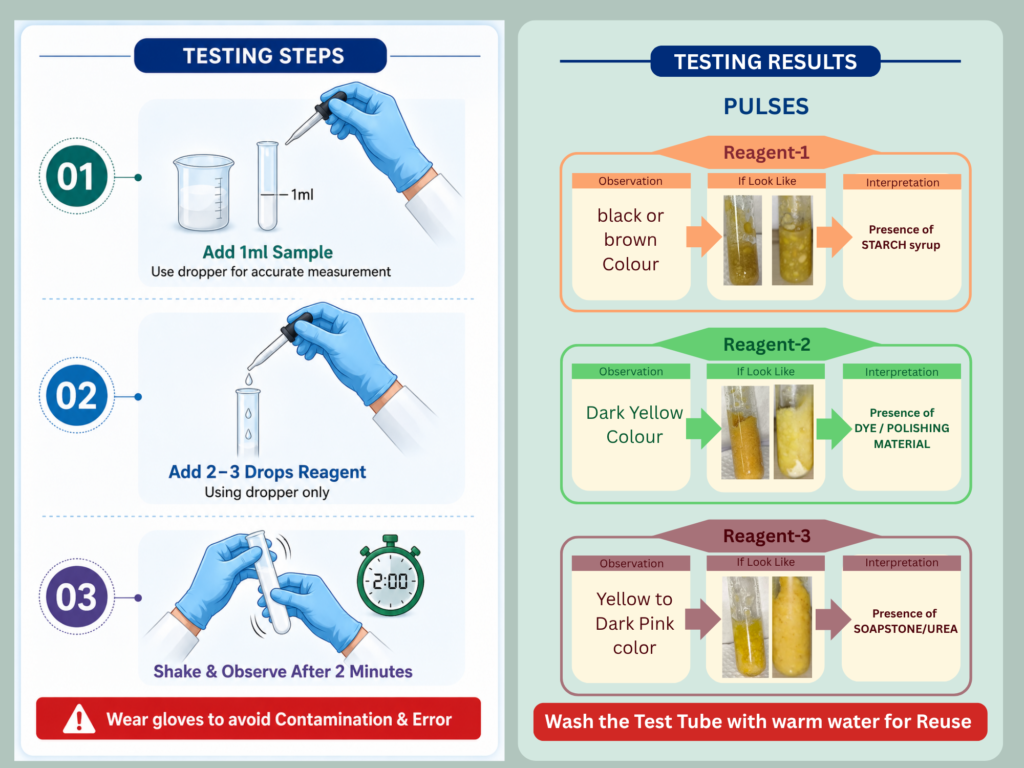
STARCH ADULTERATION DETECTION PROCEDURE
- Take a few grains or 0.1 gram of Pulses.
- Crush it slightly and add 1ml of water (for soaking the pulses), keep it for 2 minutes.
- Take the supernatant, or soaked water, in test tubes approximately 0.5 ml or a full dropper.
- Add 3 drops of the starch detecting Reagent-1 in the test tube.
- Mix it well and let it rest for 1 minute.
- Observe the color change (if any). Dark blue or black colour indicates the presence of starch in pulses to increase the weight of pulses.
DYE/POLISHING DETECTION PROCEDURE
- Take a few grains or 0.1 gram of Pulses.
- Crush it slightly and add 1 ml of water (for soaking the pulses), keep it for 2 minutes.
- Take the supernatant or soaked water, in test tubes approx. 0.5 ml or a full dropper.
- Add 2 drops of the Dye/Polishing detecting Reagent-2 in test tube.
- Mix it and leave for 1 minute.
- Observe the color change (if any). Color changed to dark yellow, pink means pulses contain metanil yellow dye, or other dye adulteration for color and shine enhancement of pulses.
SOAPSTONE/UREA DETECTION PROCEDURE
- Take a few grains or 0.1 gram of Pulses
- Crush it slightly and add 1 ml of water (for soaking the pulses), keep it for 2 minutes
- Take the supernatant or soaked water in test tubes approx. 0.5 ml or a full dropper
- Add 3 drops of the Dye/Polishing detecting Reagent-3 in the test tube
- Mix it and leave for 1 minute.
- Observe the color change. if, the color changed to dark pink or red means pulses contain soapstone or urea adulteration for weight and shine enhancement of pulses.
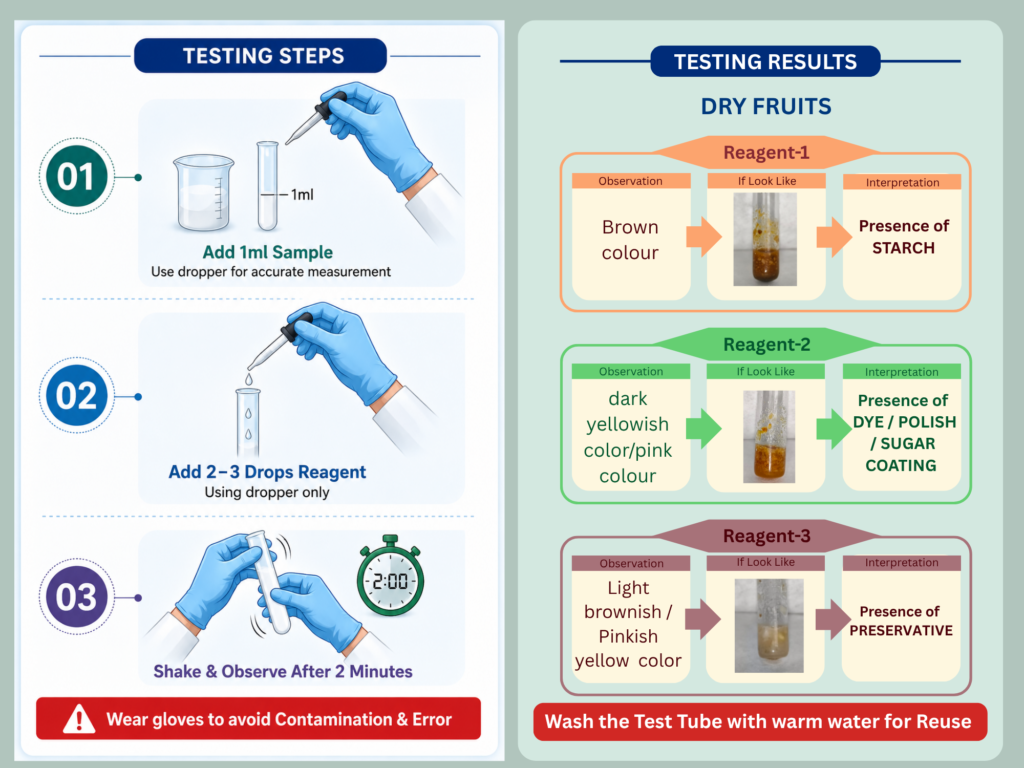
DRY FRUITS ADULTERATION DETECTION RAPID TEST KIT
मेवे में मिलावट की पहचान हेतु त्वरित परीक्षण किट
Adulteration in dry fruits is a growing issue in India, where dishonest suppliers often add low-quality or harmful substances to increase profit margins. One common practice is to mix dry fruits with cheaper, lower-quality nuts or seeds that lack the same nutritional value. Artificial colors and coatings, such as chemical dyes or wax, are applied to enhance the appearance of dry fruits, making them look fresh and appealing but potentially harmful to your health. In some cases, glucose or sugar syrups are used to sweeten raisins or dates, adding unwanted calories and reducing their natural benefits. To prolong shelf life, chemical preservatives like sulfur dioxide are added to products like apricots, figs, and raisins. These substances, while keeping the dry fruits looking fresh, can cause allergies or other health issues. Even more alarming, some dry fruits are treated with mineral oil to give them a glossy finish, masking their actual quality. The next time you reach for a handful of dry fruits, it’s worth considering what else might be lurking in that pack beyond just nature’s goodness.
HOW TO TEST
STARCH ADULTERATION DETECTION PROCEDURE
- Take one piece of any dry fruit and crush it.
- Take a small amount of dry fruit powder in the given test tube
- Add 0.5 ml of water (for soaking the powder) mix it well, keep it for 1 minute
- Add 2-3 drops of the starch detecting Reagent-1 in the test tube
- Mix it and leave for 1 minutes
- Observe the color change (if any). Dark brown or black color indicates the starch adulteration to increase the weight of Dry fruits.
DYE/POLISHING & SUGAR COATING DETECTION PROCEDURE
- Take one piece of any dry fruit and crush it.
- Take a small amount of dry fruit powder in the given test tube
- Add 0.5 ml of water (for soaking the powder), mix it well, and keep it for 1 minute
- Add 4 drops of the Testing Reagent-2 to the test tube
- If the color changes to dark yellow/ pink means dry fruits contain dye or other adulteration for color and shine enhancement of dry fruits.
PRESERVATIVES DETECTION PROCEDURE
- Take one piece of any dry fruit and crush it.
- Take a small amount of dry fruit powder in the given test tube
- Add 1 ml of water (for soaking the powder), mix it well, and keep it for 1 minute
- Add 4 drops of the Reagent-3 to the test tube
- The development of a pinkish-yellow color indicates the presence of preservatives or flavors in dry fruits, used to improve their appearance or prolong their shelf life.
JAGGERY ADULTERATION DETECTION RAPID TEST KIT
गुड़ में मिलावट की पहचान हेतु त्वरित परीक्षण किट
In India, impurities in jaggery are a widespread concern. Unscrupulous producers often add chalk powder, washing soda, or even artificial sweeteners like saccharin to increase the weight and sweetness of jaggery. One common adulterant is sodium bicarbonate, which is used to give jaggery a bright, attractive color, but it compromises its quality. Similarly, low-cost synthetic sweeteners or glucose are mixed into jaggery to cut costs and boost profits. Sulphur, used in the processing of jaggery to enhance color and texture, leaves harmful residues that can affect health. Additionally, some producers add chemical preservatives like sodium benzoate to extend the shelf life, posing potential health risks. The jaggery you think is pure may be laden with these dangerous substances, affecting not only its nutritional value but also your well-being.
HOW TO TEST
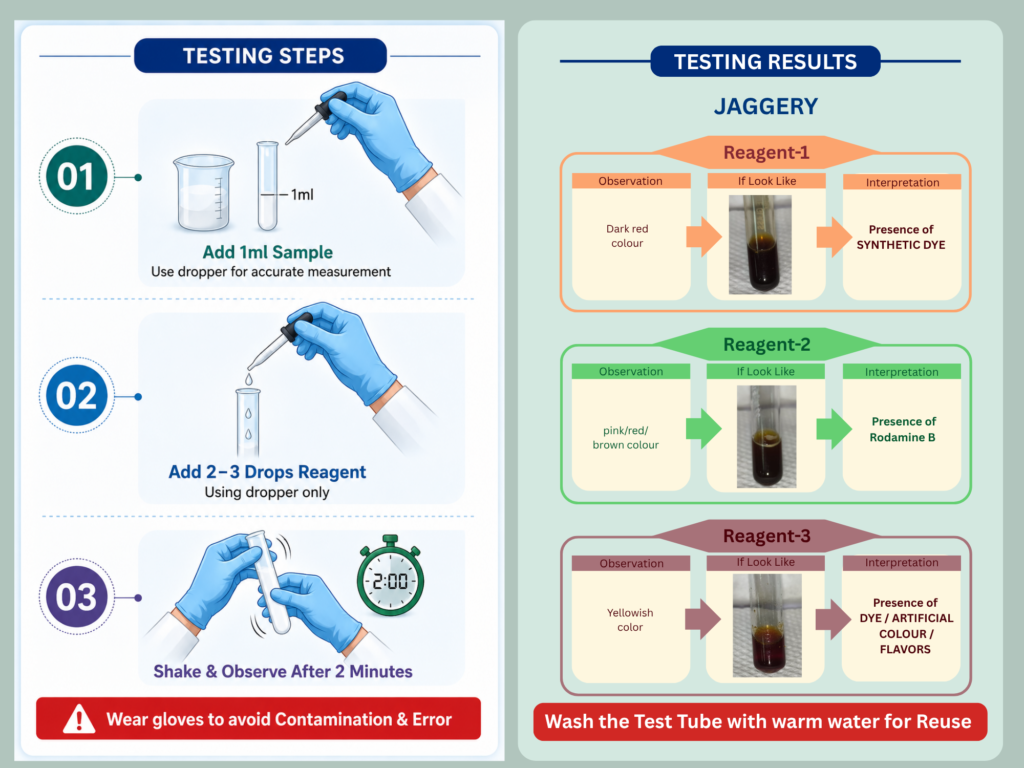
DYE/ ARTIFICIAL COLORS/FLAVORS/ PRESERVATIVES DETECTION PROCEDURE
- Wear the safety gloves provided in the kit.
- Take approx. 100 mg or a pinch of jaggery and mash it, and add it to the given test tube.
- Add 2 to 3 drops of adulteration detection Reagent-1 given with the kit in jaggery.
- Observe the color change. If the color changes to red/yellow, it indicates that jaggery is adulterated with synthetic dye. Pure jaggery should not change color.
RODAMINE-B ADULTERATION DETECTION PROCEDURE
- Take aprox. 100 mg or a pinch of Jaggery and mash it, add to the given test tube.
- Add 3 drops of Reagent-2 in Jaggery, dip it and mix well.
- Shake & mix gently to facilitate the dissolution of jaggery in the solution.
- Allow the mixture to stand for about 1-2 minutes.
- Observe the mixture. Deep brown/Red color appears, it contains adulterants. If the jaggery dissolves entirely in the solution, without any visible residue, it suggests that the jaggery is relatively pure.
DYE/ ARTIFICIAL COLORS/FLAVORS/ PRESERVATIVES DETECTION PROCEDURE
- Take aprox. 100 mg or a pinch of Jaggery and mash it, add to the given test tube.
- Add a dropper full of water to the Jaggery and mix well.
- Add 4 drops of Reagent-3 given with the kit.
- Development of pinkish Red/Yellow color indicates the presence of preservatives/artificial colors, and flavors in Jaggery to improve its appearance and prolong its shelf life.
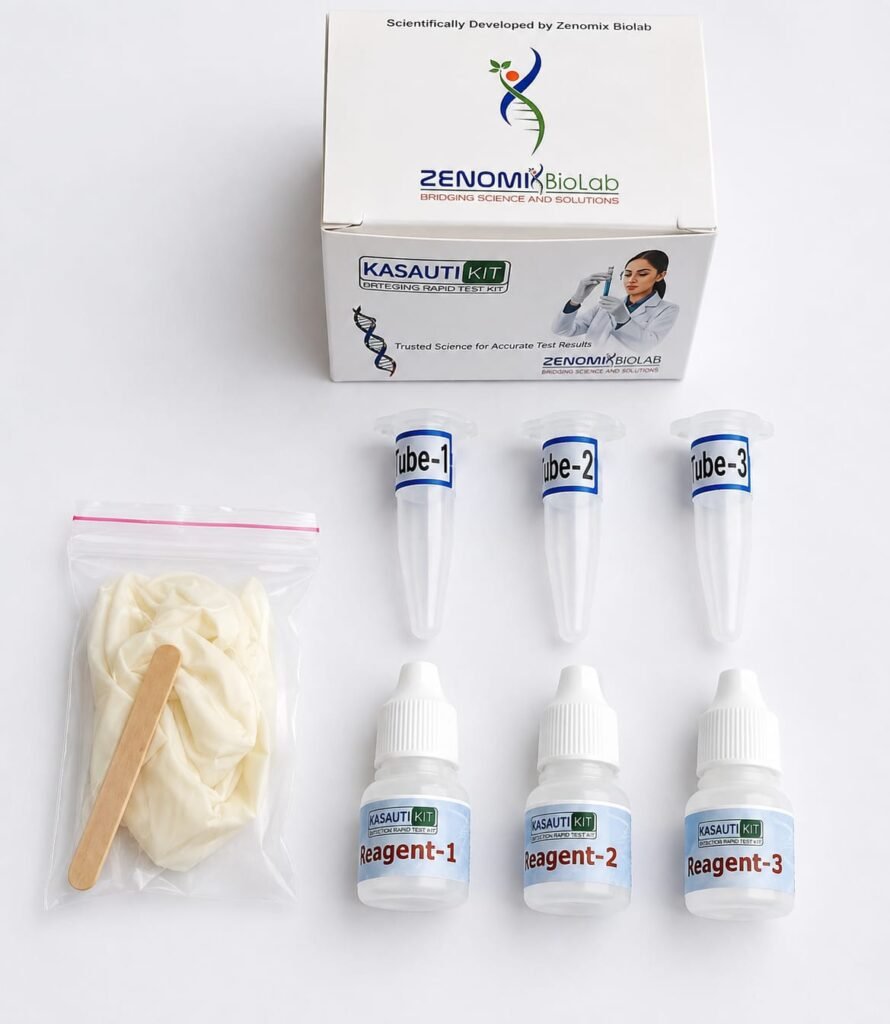
Single-Use Kasauti Kit
IN BOX & POUCH
This kit is also reagent-based but can be used for single use only. All the accessories required for the test is kept in the kit box. This form of kit is made for the BRANDS to build customer trust by proving to customer along with their product.
This is especially for the brands. Which are dealing in
- Milk,
- Ghee,
- Edible oil,
- Honey,
- Spices,
- Pulses,
- Butter,
- Jaggery,
- Paneer, and
- Dry fruits
Brands can offer this single-use testing kit along with their products, helping demonstrate product quality and build greater trust and confidence among their customers.
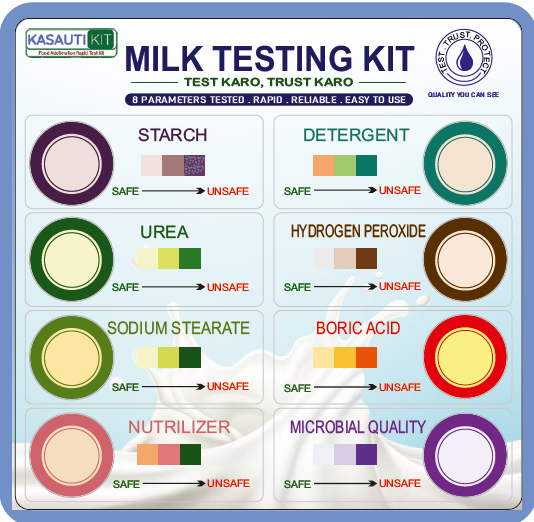
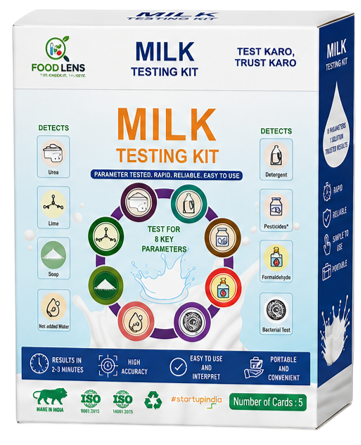
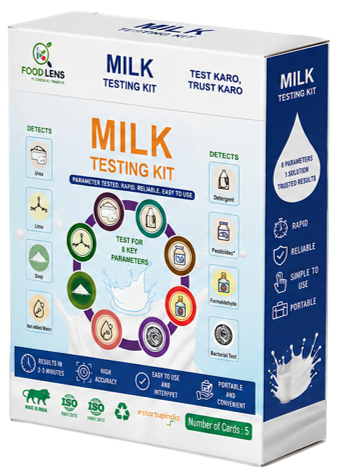
MILK-TEST CARD KIT
Easy, Quick & Convenient Milk Testing
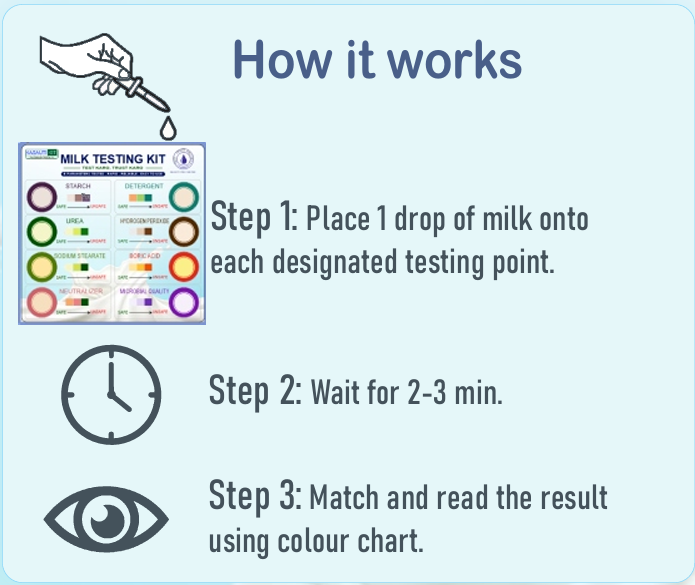
This kit is designed to make milk adulteration testing simple, quick, and convenient. Available in an easy-to-use card format, it requires only one drop of milk in each designated test circle.
Simply add one drop of milk to the test circle and observe the colour change. A change in colour indicates the possible presence of adulteration.
No complex equipment or laboratory setup is required—making it suitable for quick, on-the-spot screening of milk quality.
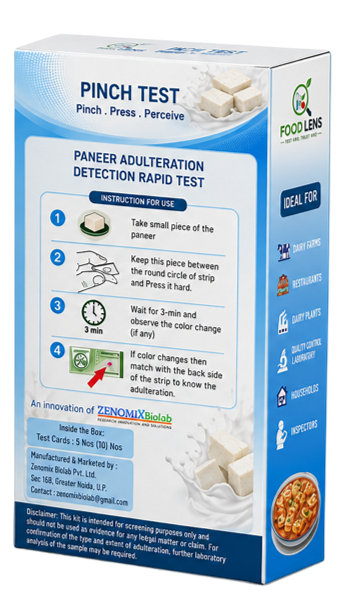
PINCH-TEST KIT
Easy, Quick & Convenient Paneer Testing
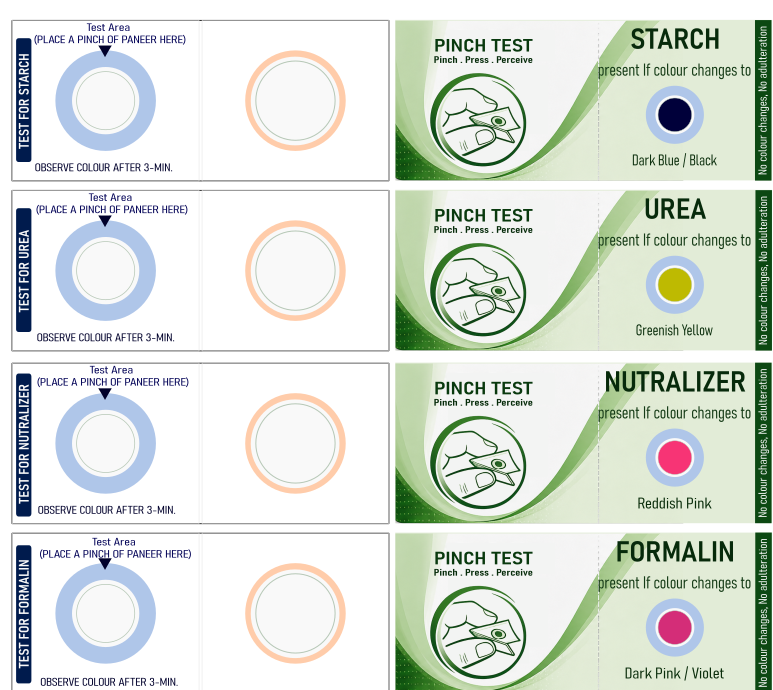
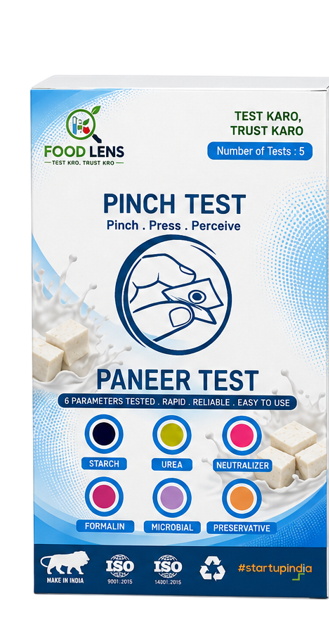
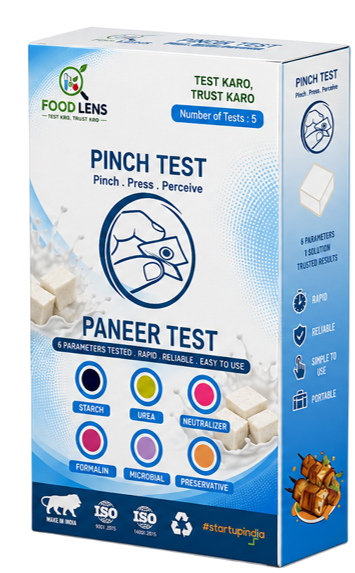
The Paneer Testing Kit is specially designed for quick, on-the-spot screening of 6 types of paneer adulteration, delivering results within minutes. Its simple and innovative strip-based format makes paneer testing easy, convenient, and accessible—without the need for complex laboratory procedures.
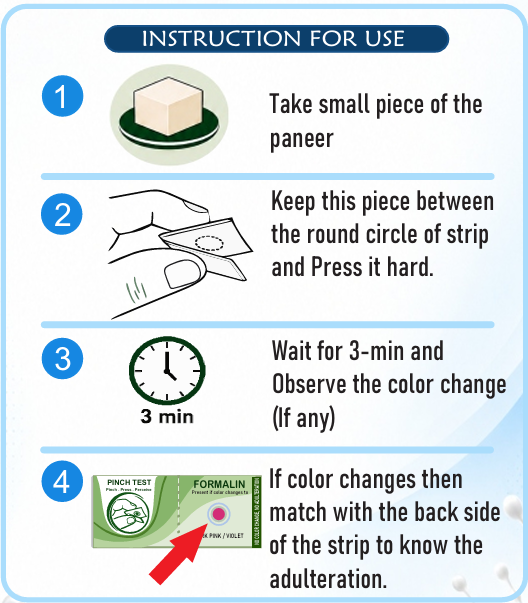
Simply take one pinch of paneer, place it between the two sides of the test strip, and press firmly. Wait for a few minutes and observe the result.
A visible color change indicates the possible presence of adulteration.
No specialized equipment, laboratory setup, or technical expertise is required. The kit is ideal for dairy farms, dairy plants, restaurants, quality-control laboratories, households, and food inspectors looking for a convenient preliminary screening solution.