
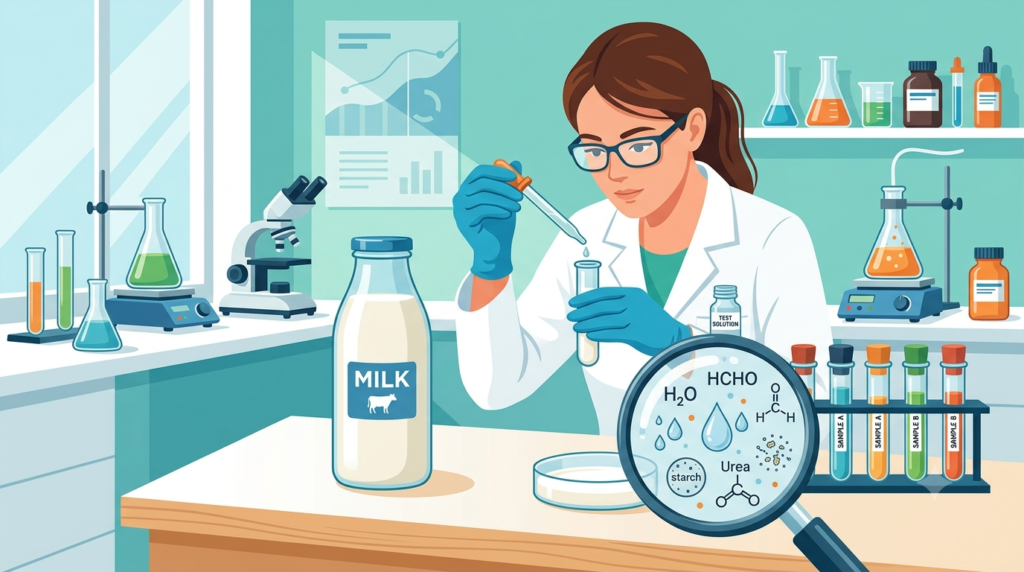
Milk is one of the first foods we consume—but how sure are you that the milk in your glass is actually pure?
For millions of Indian households, milk is part of the daily routine—added to tea and coffee, poured over cereal, used to make curd and paneer, or simply enjoyed as a drink.
But milk purity is about more than how white, thick, or fresh the milk looks. Milk quality can be affected by its natural composition, handling, storage, processing, and, in some cases, intentional adulteration.
The good news? There is no need for panic. The right approach is awareness, sensible purchasing, and appropriate testing.
What Does “Pure Milk” Actually Mean?
When consumers say they want “pure milk,” they generally mean milk that has not been deliberately diluted or mixed with substances that should not be present.
However, milk is a natural product, so its composition can vary. Factors such as:
- Animal species and breed
- Feed and nutrition
- Season
- Stage of lactation
- Animal health
- Processing and storage conditions
can influence characteristics such as fat, protein, solids-not-fat (SNF), and other components.
Therefore, a difference in thickness or appearance does not automatically mean adulteration.
Food safety authorities such as the Food Safety and Standards Authority of India (FSSAI) establish standards and analytical methods for milk and milk products. FSSAI’s current resources include standards for food products and a revised manual for analysis of dairy and dairy products.
In simple words: pure milk should meet the applicable quality and safety requirements for the type of milk being sold.
Common Milk Adulterants
Milk adulteration can involve adding water, manipulating composition, or introducing substances that are not appropriate ingredients of milk.
| Adulterant / Substance | Why it may be added | Possible concern |
|---|---|---|
| Water | To increase volume | Dilutes nutrients and changes milk composition |
| Starch | May be used to increase apparent solids/thickness | Indicates adulteration and may be unsuitable for some individuals |
| Urea | Can be used to artificially increase apparent nitrogen/protein measurements | Excessive intake can be harmful |
| Detergents/surfactants | May be associated with attempts to mimic some properties of milk | Can cause gastrointestinal irritation and other adverse effects |
| Hydrogen peroxide | May be used improperly as a preservative | Unauthorised use can create food-safety concerns |
| Neutralizers | May be used to mask acidity or delay signs of spoilage | Indicates improper handling/adulteration |
| Added sugar or other solids | May alter measured composition or characteristics | Unauthorised addition may make the product non-compliant |
FSSAI’s analytical manual specifically includes methods for detecting substances such as starch, added urea, detergents, formalin, hydrogen peroxide, neutralizers and several other potential adulterants in milk.
Importantly, this list does not mean that these substances are present in all milk. Adulteration varies according to the source, handling practices, and circumstances.
Why Is Milk Adulterated?
The main motivation behind intentional adulteration is generally economic gain.
For example, adding water can increase the volume of milk. But dilution also changes the concentration of naturally occurring milk components.
Other substances may be added in an attempt to:
- Increase apparent solids
- Improve thickness or appearance
- Mask changes associated with poor-quality or deteriorating milk
- Manipulate certain quality measurements
- Extend shelf life improperly
FSSAI has noted that milk’s relatively high water content and opaque appearance can make certain forms of adulteration difficult to detect visually. Its testing manual also identifies undue economic benefit as a key motive for milk adulteration.
What Are the Possible Health Concerns?
The health impact depends on what has been added, how much is present, and how frequently it is consumed.
1. Water
Water itself is not necessarily harmful when it is safe drinking water. However, deliberately adding water to milk reduces the concentration of nutrients and changes the expected composition of the product.
If the added water is contaminated, it can also introduce microorganisms or other contaminants.
2. Starch
Starch may be used to alter the apparent solids or thickness of diluted milk.
Its presence can indicate adulteration. For individuals with specific dietary restrictions or sensitivities, unintended starch addition may also be relevant.
3. Urea
Milk naturally contains nitrogen-containing compounds, but intentional addition of urea is not an acceptable way to increase the nutritional quality of milk.
High exposure to inappropriate amounts of urea can create health concerns.
4. Detergents and Surfactants
Detergents are not ingredients of milk.
Their presence can be particularly concerning because these substances are formulated for cleaning rather than consumption and may cause gastrointestinal irritation and other adverse effects.
5. Other Chemicals
Substances such as hydrogen peroxide, formalin, borates, or neutralizing agents may appear in adulteration discussions because analytical methods exist for their detection.
Their intentional or unauthorised presence in milk is a food-safety and regulatory concern.
The important point is this: don’t believe sensational claims that every adulterated milk sample causes a specific disease. The actual risk depends on the substance, concentration, exposure and individual circumstances.
Can You Test Milk at Home?
Yes—but with an important qualification.
Some screening tests can help consumers or field workers identify possible adulteration. FSSAI itself publishes analytical methods for detecting several milk adulterants, including starch, urea, detergents, formalin and hydrogen peroxide.
For example, a simple screening approach may look for:
- Starch
- Unusual physical characteristics
- Certain chemical adulterants using appropriate test methods
However, a home or rapid test should not automatically be treated as definitive laboratory proof.
Screening tests can indicate a possible problem, but a positive result should ideally be confirmed by an appropriate laboratory method.
This distinction is extremely important.
A visual observation, internet “home hack,” or rapid test cannot replace proper laboratory analysis when a regulatory or legal conclusion is required.
How to Buy and Store Milk Safely
You can reduce many food-safety risks by following a few simple habits.
When buying milk
1. Choose reliable sources
Buy milk from reputable dairy suppliers, retailers, or brands with appropriate regulatory compliance.
2. Check the package carefully
Look at the product name, batch information, date marking, storage instructions and other required label information.
3. Check packaging integrity
Avoid packs that are leaking, swollen, damaged or otherwise compromised.
4. Don’t judge purity by appearance alone
Milk that looks thick is not automatically pure, and milk that looks thin is not automatically adulterated.
After purchase
5. Maintain the cold chain
Keep milk appropriately refrigerated and minimise the time it remains at room temperature.
6. Follow the manufacturer’s storage instructions.
7. Use opened milk appropriately and promptly.
And remember:
Boiling milk is useful for reducing many microbial risks, but boiling does not guarantee removal of chemical adulterants.
Myths vs Facts
Myth 1: Thick milk is always pure.
Fact: Thickness alone cannot prove milk purity. Milk composition naturally varies, and adulteration cannot reliably be judged by appearance alone.
Myth 2: Thin milk is always adulterated.
Fact: Not necessarily. Natural variation, processing and dilution can all affect milk’s physical characteristics.
Myth 3: Boiling removes all adulterants.
Fact: Boiling can help control many microorganisms, but it does not necessarily remove chemical adulterants.
Myth 4: Packaged milk can never be adulterated.
Fact: Packaged milk is subject to food-safety and quality controls, but consumers should still check the label, packaging and storage conditions.
Myth 5: Every milk sample in India is adulterated.
Fact: This is not supported by FSSAI’s national milk survey. In its 2018 survey of 6,432 samples, FSSAI reported that 93% of samples were found safe for consumption, while also identifying quality and safety issues in a subset of samples.
Myth 6: A single home test can prove that milk is completely pure.
Fact: A screening test can target a particular adulterant, but no single simple test proves that milk is free from every possible adulterant or contaminant.
What Should You Do If You Suspect Milk Adulteration?
Lorem ipsum dolor sit amet, consectetur adipiscing elit. Ut elit tellus, luctus nec ullamcorper mattis, pulvinar dapibus leo.
How to Buy and Store Milk Safely
If you genuinely suspect that your milk may be adulterated:
Don’t panic—and don’t rely only on social media claims.
Instead:
- Stop using the product if there is a clear safety concern.
- Keep the packaging, batch number and purchase information.
- Contact the seller or manufacturer where appropriate.
- Consider having the sample tested by an appropriate food-testing laboratory.
- If necessary, report the concern through the relevant food-safety authority.
- Avoid making a public accusation based solely on an unverified home test.
A laboratory confirmation is particularly important when the result may lead to a regulatory, commercial or legal action.
Milk Safety Is About More Than Adulteration
It is also worth remembering that milk safety and milk adulteration are not exactly the same thing.
Milk can have a quality or safety issue because of:
- Microbial contamination
- Poor hygiene
- Improper refrigeration
- Antibiotic residues above applicable limits
- Environmental contaminants
- Feed-related contaminants
- Adulteration
For example, FSSAI’s 2018 national milk survey assessed both quality and safety parameters, including residues and contaminants—not just intentional adulteration.
That is why a good food-safety approach looks beyond the question:
“Is anything added to my milk?”
and also asks:
“Was the milk produced, handled, transported and stored safely?”
The Bottom Line
Milk is an important part of the Indian diet, and consumers deserve confidence in the food they buy.
But determining milk purity isn’t as simple as checking whether the milk looks white, thick or creamy.
Real milk quality requires science.
Buy from reliable sources, follow proper storage practices, understand the limitations of home screening tests, and seek laboratory confirmation when there is genuine concern.
Most importantly, don’t let viral claims create unnecessary fear. Food safety is best protected through awareness, evidence and responsible testing—not rumours.
Know what you eat. Test what you can. Choose food you can trust.
Follow FoodLens for practical, science-based food safety awareness.
Know what you eat. Test what you can. Choose food you can trust.
Follow FoodLens for practical, science-based food safety awareness.
Frequently Asked Questions
1. What is milk adulteration?
Milk adulteration is the intentional addition, removal or alteration of substances in milk in a way that makes the product non-compliant with applicable quality or safety requirements.
2. What are common milk adulterants?
Potential adulterants include water, starch, urea, detergents/surfactants, inappropriate preservatives and neutralizing substances. FSSAI’s analytical methods cover a range of these substances.
3. How can I test milk adulteration?
Some rapid or household screening tests can target specific adulterants such as starch. However, screening does not establish complete milk purity. Suspicious results should ideally be confirmed through appropriate laboratory testing.
4. Does boiling remove adulterants from milk?
Not necessarily. Boiling can reduce many microbial hazards, but it should not be considered a method for removing chemical adulterants.
5. Is all milk in India adulterated?
No. FSSAI’s national survey did not support the claim that all or most milk is adulterated. However, the survey did identify specific safety and quality issues, demonstrating why continued monitoring and responsible testing remain important.